
Angel portfolio math: why diversification is everything
By TechAngels · Published 17 July 2026
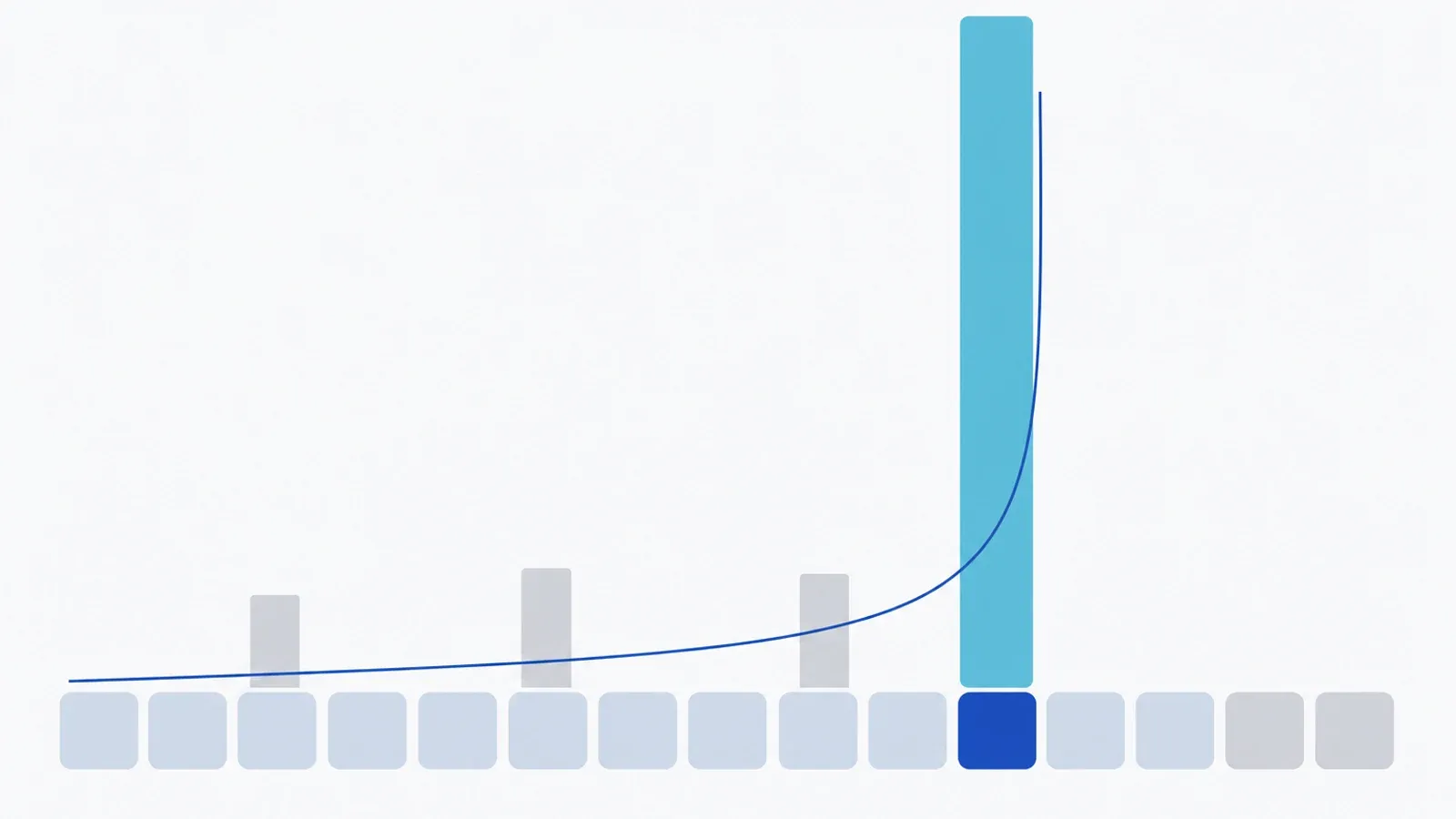
An angel portfolio can contain many failures and still produce a positive gross return. It can also contain several respectable companies and lose money because it missed the exceptional outcome that would have paid for the rest. Early-stage returns are highly uneven, so cheque size, portfolio size and pacing matter alongside company selection.
No portfolio formula makes angel investing safe. Diversification changes exposure to individual-company risk; it does not remove market risk, illiquidity, dilution or the possibility that an entire portfolio performs poorly.
What a power-law distribution means for your returns
A power-law distribution is one where a few extreme outcomes account for most of the total, while the vast majority of cases sit near zero. Startup returns behave this way: the worst outcome is capped (you lose your cheque, so the most any single deal costs you is 1x), but the best outcome is effectively uncapped (a company can return 10x, 30x, or more). Losses and modest wins cluster at the bottom; a handful of outliers sit far out on the tail and carry the portfolio.
The practical consequence is that avoiding every loss is not a realistic investment process. More positions increase the chance of owning an outlier, although the probability and return distribution cannot be known in advance for a particular portfolio. Empirical results also depend on how failures, unrealised holdings and follow-on capital are counted.
Why many small cheques beat a few large ones
Concentration places more of the result on a small number of selection decisions. At pre-seed, where evidence is limited, confidence in those decisions can exceed what the data supports. Dividing an allocation among more companies reduces the damage from any one failure and increases exposure to different teams, sectors and vintages.
Syndication can make that allocation practical by allowing several investors to fund a round without any one of them taking the entire position. It is a portfolio tool, not proof that the underlying company is good. See angel investment syndication for the legal and operational distinctions.
A worked example (illustrative, not real data)
The numbers below are hypothetical and chosen to show the arithmetic; they are not empirical results from any portfolio. Suppose you build a portfolio of 15 investments and write an equal cheque of €15,000 into each, for €225,000 deployed in total.
Assume the outcomes land like this:
- 8 companies fail and return nothing: 8 × €0 = €0
- 5 companies roughly return your money: 5 × €15,000 = €75,000
- 1 company returns 3x: €45,000
- 1 company returns 20x: €300,000
Add them up and the portfolio returns €420,000 on €225,000 invested, a gross multiple of roughly 1.9x. Now look at where that money came from. The single 20x company produced €300,000, about 71% of everything the portfolio returned. Take that one deal out and you are left with €120,000 back on €225,000, a loss. More than half your companies failed outright, and the portfolio still made money, because one position in the tail did the work of all the others.
Two honesty notes on that arithmetic. It is a gross multiple: dilution from later rounds, taxes, any costs, and the years the money is locked up all sit between that 1.9x and what lands in your account, so the annualized return is much less flattering than the multiple. And reported angel returns skew optimistic, because angels with failed portfolios tend to stop reporting.
That is the power law in one page. The lesson is not that 20x outcomes are common; they are rare, which is precisely why you need enough positions to have a shot at owning one.
Sizing your tickets from your total allocation
Work backwards from the total you can afford to lose, never forwards from a company you like. Angel capital should be money that can go to zero without changing your life; it sits at the far end of a risk spectrum, and the power law guarantees that most of the individual bets will in fact go to zero. Decide that total allocation first.
Then divide it into enough cheques to make the plan internally consistent. Fifteen to twenty positions is often used as a planning illustration, not a threshold that guarantees diversification or return. The right number depends on the total allocation, minimum practical cheque, access to deal flow and the capital reserved for follow-on rounds.
Keep reserves for follow-on. Some of your companies will raise again, and the winners are worth backing a second time when you have new information. Angels routinely split their capital between initial cheques and follow-on into companies already in the portfolio; in 2022, TechAngels members’ reported investing split roughly 50/50 between initial and follow-on. If you deploy every euro into first cheques, you will have nothing left to put into the deals that are actually working.
Pacing: think in years, not months
You cannot build a diversified angel portfolio in a quarter, and you should not try. Deploying your whole allocation into whatever deals happen to be open this month concentrates your portfolio in a single vintage and a single market mood. Spreading the same capital over three to four years diversifies you across time as well as across companies, so a slow year for deal quality does not swallow your budget.
Pacing also protects the follow-on reserve. If you commit slowly, you still have capital available when a portfolio company raises its next round, which is exactly when you want to be able to act. Treat your allocation as a multi-year programme with a rough number of cheques per year, not a lump sum to spend.
The waiting period changes the calculation
Failures are often recognised before successful companies produce cash. Meanwhile, the valuation of an unrealised holding is not an exit. A portfolio can therefore look weak for years, and later paper gains may still disappear before shares are sold.
Measure at least three things separately:
- cash invested, including follow-on cheques;
- cash returned, after transaction costs and tax;
- estimated value of unrealised holdings, with the valuation date and method recorded.
Gross multiple alone ignores time. Returning 1.9x after three years and after twelve years are economically different outcomes. Internal rate of return can help compare timing, but it remains sensitive to assumptions about unrealised values.
Before investing, write a policy covering the total loss-bearing allocation, maximum initial cheque, target number of positions, deployment period and follow-on reserve. Revisit it deliberately rather than changing it whenever an unusually persuasive founder appears.
The due-diligence guide addresses company selection; how to become a business angel in Romania covers structure and legal context. Neither turns the illustrative arithmetic above into a forecast.